


 |
 |
 |
 |
Fabrication
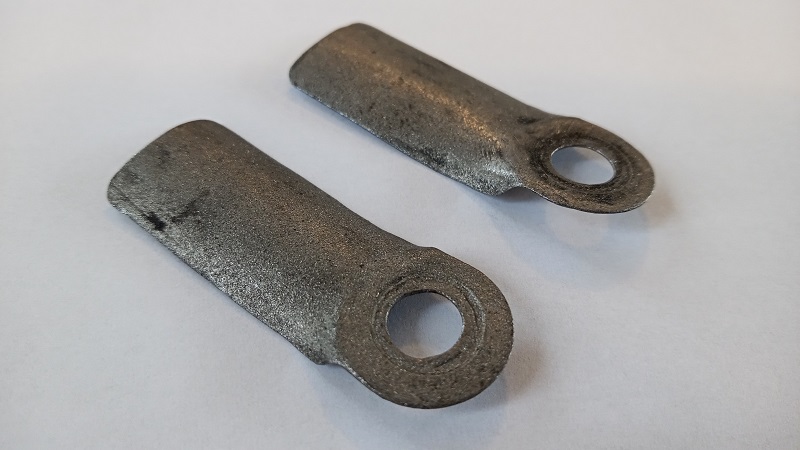
I won't dwell too much on making copies of these handles. A 0.5 mm black steel bar is needed. You need to trace and cut out the shape and the screw hole as precisely as possible and then profile it according to the above photos. The factory coating was probably black paint (at least on civilian motorcycles).
It is a bit of a mystery that although the number 56 388 is repeated in many places in various parts catalogs ... on one page of the parts catalog 601 OSL there is a parallel number 103 123. If it is not an editing error, it indicates some additional version of this parts, perhaps differing even in anti-corrosion coating, or maybe sheet thickness (?).
Application
While there are no doubts about the other brackets and clips in the parts catalog, there are some question marks in the case of item 56 388.
Exploded drawings of the front suspension components in parts catalogs show a slightly different assembly method in the 351/501 S/OS/OSL than in the 601 OSL/OS-WH. In the 351/501 catalog from 1938, it can be seen that this part is installed from the bottom of the handlebar stem with the bulge upwards. In the case of 601, the plate is from the top and the bulge is directed upwards. And that makes some sense, and is probably correct for the 351/501 OSL as well. The cable casings rest on the handlebar brackets from the top (see the photo below from the factory NSU publishing house from the late 1930s), so the metal covers could be some kind of protection (against rubbing of the handlebar stem with armor moving during turns).
 And this is how it looks in individual parts catalogues:


I am extremely curious about your ideas and opinions in this regard - I invite you to the appropriate thread on our forum (link).


